
 𝘛𝘩𝘦 𝘙𝘦𝘵𝘶𝘳𝘯 𝘵𝘰 𝘢 𝘗𝘭𝘢𝘤𝘦 𝘐 𝘏𝘢𝘥 𝘕𝘦𝘷𝘦𝘳 𝘉𝘦𝘦𝘯 𝘉𝘦𝘧𝘰𝘳𝘦
Every time I passed through Lisbon and crossed Eduardo VII Park, I’d look up at the building perched at the top of the avenue and think: “One day.”
It was a promise deferred over the years, while the city transformed around me.
This time, I didn’t pass by. I stepped inside.
And it felt like crossing not just a marble lobby, but a threshold in time. A Lisbon suspended in the 1950s – a city of diplomats, discreet spies, conversations cut short in cafés, dossiers passed quietly in hallways – met a luminous, creative contemporary Lisbon, in that grand hall where history seems to intersect.
The Ritz was born in 1959 as the showpiece of a regime eager to project international sophistication. Today, it stands as a precise portrait of a Lisbon that has grown into itself – cosmopolitan, elegant, a classic that has learned how to move with the times.

Arrival
There’s a rare quality in the Ritz that one feels upon entering: the atmosphere is dense, inhabited, as though the building holds decades of whispered conversations.
The atrium strikes that perfect geometry between grandeur and restraint. Cream-toned marble glowing in the afternoon light, floral arrangements of architectural scale, generous staircases – and at the far end, a terrace that frames the deep green of Eduardo VII Park like a living painting.

Check-in was swift and seamless. That unhurried precision found only in places that have never needed to prove anything to anyone.
I noticed the details: the way the flowers punctuate the space without overwhelming it; the balance between emptiness and presence. Staff glide with contained gestures and low voices, as if they’ve memorised the building.
Three small rituals on arrival: still-warm pastéis de nata, the delicate crackle of flaky pastry under teeth; a glass of Port offered not as formality but as welcome conversation; and fresh fruit, a quiet contrast of simplicity.

That’s when I realised: the Ritz Four Seasons Lisbon is one of those rare hotels where everything is where it should be.
Lisbon and the World
I sat at the Almada Negreiros Lounge while our room was being prepared, and did what any attentive traveller might: I observed.
In the morning, discreet meetings: dark suits, slim portfolios, conversations in English, French, Arabic.

In the afternoon, multigenerational families: elegant grandparents who’ve seen the world, teenage grandchildren discovering what luxury feels like, handshakes that closed successful deals. At sunset, the oblique light poured through the stained-glass windows, and the city slowed. The Ritz slowed with it.
In the 60s and 70s, this lobby was a crossroads: diplomats exchanging dossiers, artists and writers eavesdropping and sketching characters. Today, the flow has shifted, but the energy remains: Silicon Valley entrepreneurs, Middle Eastern families, European creatives who’ve made Lisbon a second home.
The Ritz sees Lisbon.
And Lisbon sees itself in the Ritz.

A Camera over Lisbon
Our Deluxe Park-View Room still fulfills the original intent of the project: a chamber where Lisbon enters through the balcony before we do.
Light changed throughout the day like a character: crisp and white at 9 a.m., golden and slanted by 6 p.m., cinematic as it grazed the treetops of Eduardo VII Park.

I noticed the nuances that separate decoration from thoughtful design. The blue-petrol velvet of the chairs holding warmth from the hand, the leather headboard, the wood finished with that proper degree of timeless sheen. The curtains – thick enough to create total acoustic silence when drawn.

You don’t “spend time” in this room. You inhabit it.
At night, lying in bed, I could hear Lisbon breathing slowly outside. And I understood why so many diplomats, writers, and exiles chose the Ritz over the decades: it wasn’t just about safety. It was comfort.

The Art Collection
Few hotels in the world possess an art collection as culturally rich as the Ritz. I discovered this not on a guided tour, but by wandering the corridors en route to dinner.
I paused in front of a tapestry by Almada Negreiros – centaurs drawn geometrically into the space they inhabit. Further on, Carlos Botelho’s take on Lisbon.

Then Maria Helena Vieira da Silva, with her oneiric labyrinths that ask for slow reading, that pull the eye in.
The sculptures from Lagoa Henriques hanging in Varanda restaurant – bringing the power of the sea to that iconic room.
There are no didactic plaques. No tourist signposts. The art lives as part of the architecture, as though it had always been there.

In an elevator, I overheard two American guests:
“We come back every year just to see the collection again.”
One pointed to a photo of Querubim Lapa’s column, like recognising an old friend.
Here, art is not decoration.
It is identity.
It’s how the hotel tells the story of Portugal in the 20th century.
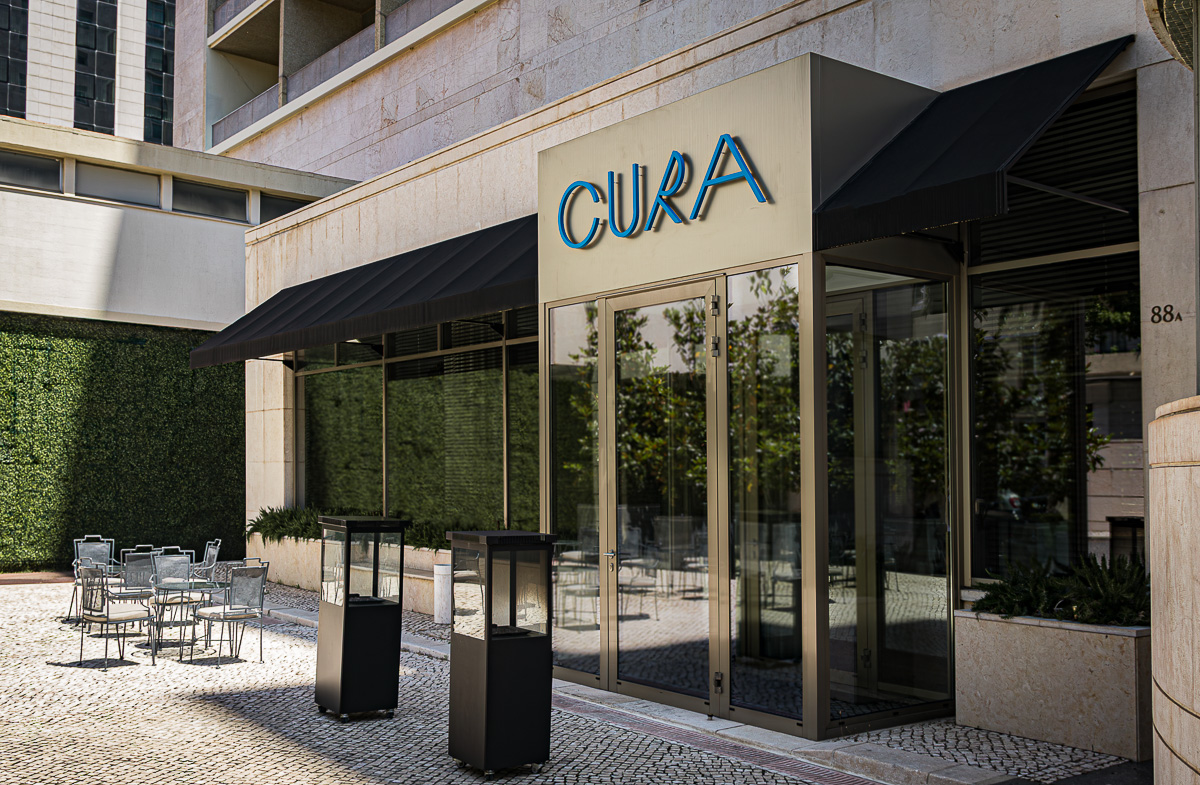
The Varanda & Cura; Two Rhythms of the Same City
Varanda is the classical soul of Lisbon, the Lisbon that once looked to France and gently folded itself in. A Portuguese sanctuary that knows how to host without haste, that doesn’t require trendiness to endure.
I had breakfast here, by a window framing the terrace and Eduardo VII Park like a living canvas. A light, still-creamy omelet, signature eggs royale, their yolk spilling cinematographically across the plate.

Executive Chef Carlos Cardoso returned to the Ritz in 2025 and leads the dining room as someone returning home.
It’s not change. It’s continuity. The art of welcoming as if Lisbon were still that reserved city of the ’50s, but now bathed in the light of today — and perhaps that’s why it still serves the city’s most revered brunch.
If Varanda is the classic soul, Michelin-starred CURA is its contemporary counterpoint, a proof that the hotel evolves at Lisbon’s pace.
Chef Rodolfo Lavrador, who took over the kitchen in 2025, works around Portuguese gastronomy with his own language, built on intention and reflection.

A bold and well-chosen path. The tasting menus feel like journeys through seasons and origins, always with a focus on sustainability.
A marker of a new Lisbon era: cosmopolitan, inventive, elegant, and utterly contemporary at the table.

SPA and Pools
The Ritz spa is one of those spaces that doesn’t photograph well, not because it lacks beauty, but because its essence is atmosphere, not image.
Reflected light, textures – stone, wood, linen – inviting touch, a hush that doesn’t need to be stated.

The outdoor pool was a surprise.
I expected something more monumental – instead, it’s discreet, almost private. The indoor one follows the same tone; here, too, art surrounds the space, extending the experience.

I observed: most guests aren’t there to swim.
They come to sit, to read, to let time decelerate by itself.

Lisbon from Above
At the top floor of the Ritz lies one of Lisbon’s best-kept secrets: a running track that circles the building with panoramic views over the city.
I don’t run, but I went up late morning, when the light embraced the city. And I understood: even those who don’t run want to be there.
Lisbon at our feet, the Tagus shining like a silver ribbon in the distance, Eduardo VII Park stretched like the city’s green carpet.
I saw three people jogging slowly — not racing, not training. They were running to get a view of Lisbon from above.
A place that transforms our perception of time.
A point where we become smaller, and the city – grander.

Between Yesterday and Tomorrow
The Ritz Four Seasons Lisbon is the mirror of a city’s reinvention.
A classic that hasn’t aged, because it has learned to move.
A hotel that holds memories of diplomacy, dictatorship, aristocracy — yet embraces a Lisbon that is creative, plural, contemporary.

A place where the old city and the new meet.
Where history, art, cuisine, and service balance in a continuous gesture.
As I left, I turned back once more toward the atrium – as if saying goodbye to a place I’d been before, even if it was my first time.
Living among hotels, we search for more than comfort and design.
We want something with roots, sophistication, humanity — something that stays in memory.
The Ritz is one of those places.

The Ritz didn’t land in Lisbon.
It was born and grows with her.
And that’s why it remains her most honest mirror.
Address: Rua Rodrigo da Fonseca, 88 – 1099-039 Lisbon
Contact: +351 21 381 14 00
Prices: Prices from €750
Heritage: Historic modernist building (1959), designed by architect Porfírio Pardal Monteiro, home to one of the largest private collections of contemporary Portuguese art (Almada Negreiros, Vieira da Silva, Carlos Botelho, Lagoa Henriques)
Facilities: SPA (1,500 m²), Pools, Rooftop Running Track (11th floor), Gym, Restaurants, Ritz Bar, Almada Negreiros Lounge, Events, Concierge, Barber Shop, Shops