
 A few days before I flew to Bombay, the restaurant sent me a short questionnaire. Some of the questions were curious, a few almost intimate for people who had never met: what I like to drink, what soundtrack I would pick for a Friday night, and others close to philosophical, far removed from anything to do with food. I answered without knowing what they were for, suspecting they would come back to me one day in another form. They did, over dinner: first as a reworked Negroni waiting for me at the bar and, hours later, as the songs each of us had chosen, slipping at random into the house playlist.
Getting there is an endurance test in itself. Bombay is a city of apparently organised chaos, where the traffic means leaving an hour early for the shortest trip and patience is the first ingredient of any dinner. In Bandra, among the lanes of Ranwar, the queue, the neon and the bright colours outside Veronica’s give away the busiest sandwich shop in town. In the bustle inside, almost no one notices the narrow staircase rising behind the coffee counter. Upstairs is another world: first a red neon sign spelling Papa’s over the old Jude’s Bakery board, then a counter and an open kitchen that have nothing to do with the noise downstairs. Hidden inside another restaurant, with no sign on the street and a back-door entrance, Papa’s could be the best-kept speakeasy in Bombay, were it not also the hardest table in town to book.
A bakery in Ranwar
Ranwar is one of Bandra’s old villages, in a neighbourhood that was Portuguese until 1739 and still keeps its 16th-century Jesuit churches. For about 80 years, Jude’s Bakery was part of the neighbourhood and of its table, and a few steps away grew up Floyd Cardoz, the cook who took Indian food to the top of New York dining with Tabla. Cardoz, who died in 2020, was also a founder of Hunger Inc., the group run by Sameer Seth and Yash Bhanage behind The Bombay Canteen and O Pedro. The team fondly called him Papaji. And it was under that name that, when the bakery came free, the group chose to honour him: first with Veronica’s, in 2023, to keep bread at the heart of the building, then with Papa’s, in the attic, in February 2024. The name and the address belong to the man who still shapes the chef and the owners, his story told fondly at the counter without turning the place into a shrine.
The cast
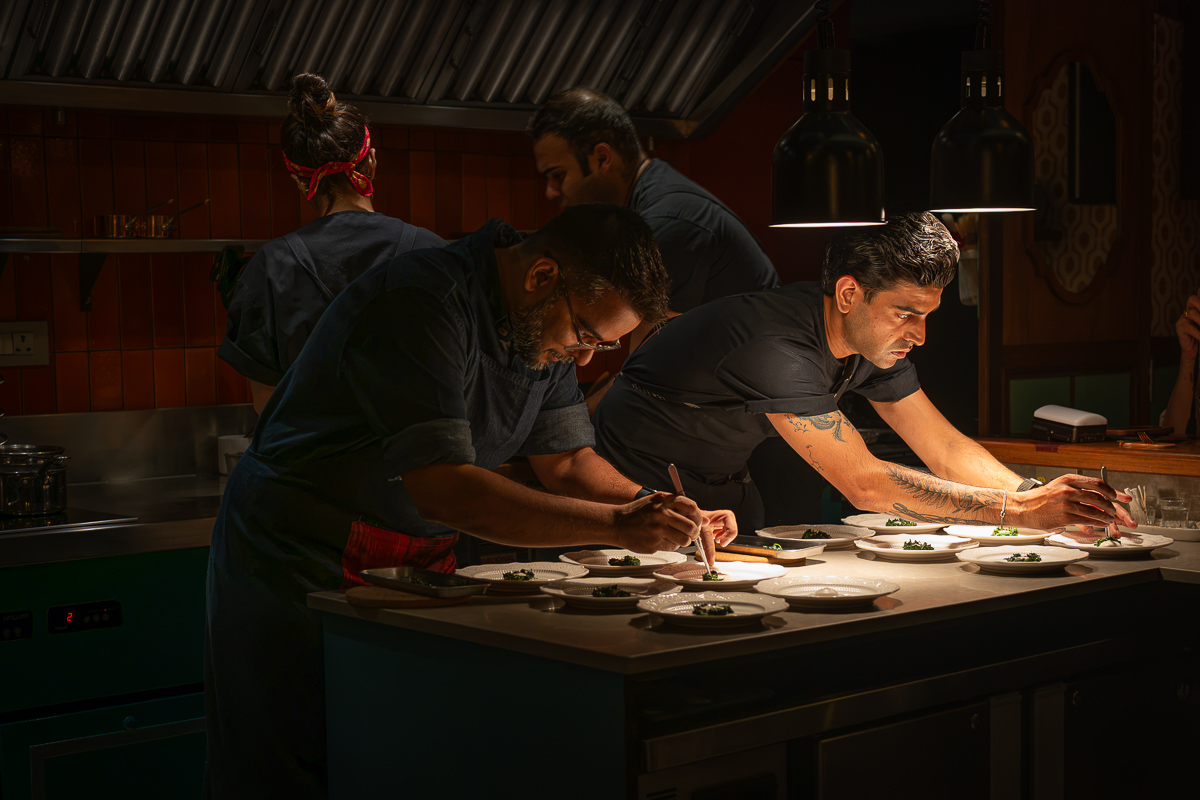
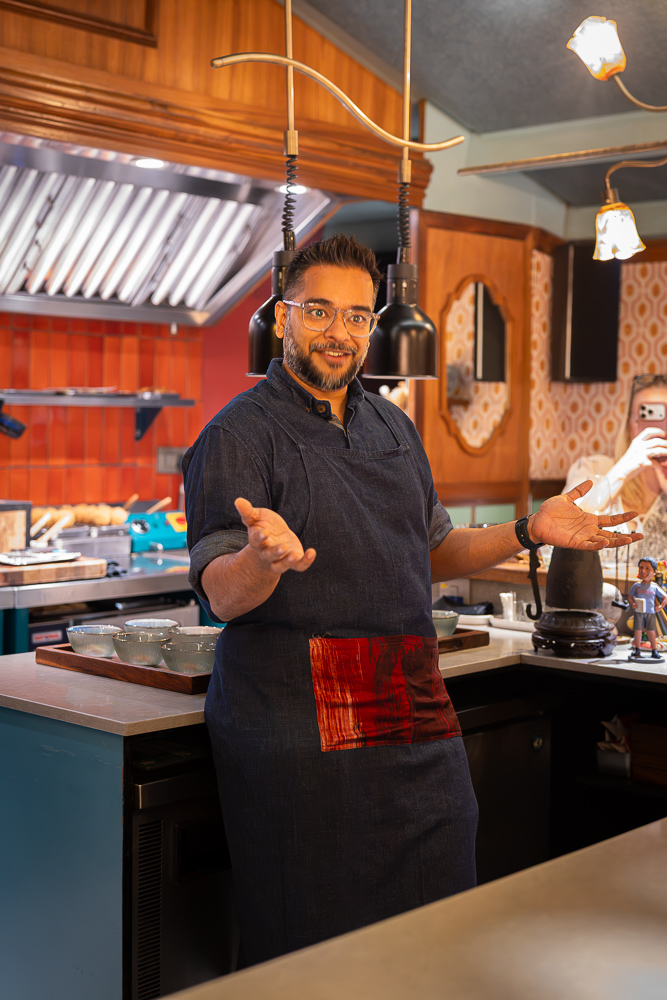
Papa’s is the epicentre of Hunger Inc., where Hussain Shahzad, the group’s executive chef, cooks without preconceived rules. Born in Chennai into a Bohri family, to a mother from Patna and a father from Bombay, Hussain came the long way round: Oberoi hotels, then Eleven Madison Park in New York, where he gained a new outlook and experience, before joining The Bombay Canteen as sous chef. Our conversations always ended up in Portugal, and for good reason: before opening O Pedro, devoted to Goan and Portuguese cooking, he spent a few months in Goa and Portugal. He ate in our villages, worked in Lisbon taverns and passed through José Avillez‘s kitchen. Between taverns and kitchens, he learnt the difference between a vinha-d’alhos and a vindaloo.
It is hard for anyone Portuguese not to smile at that, sitting in an attic thousands of kilometres from home.
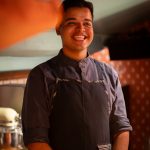
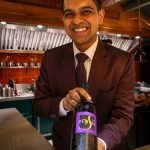
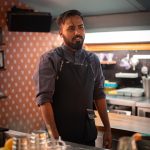
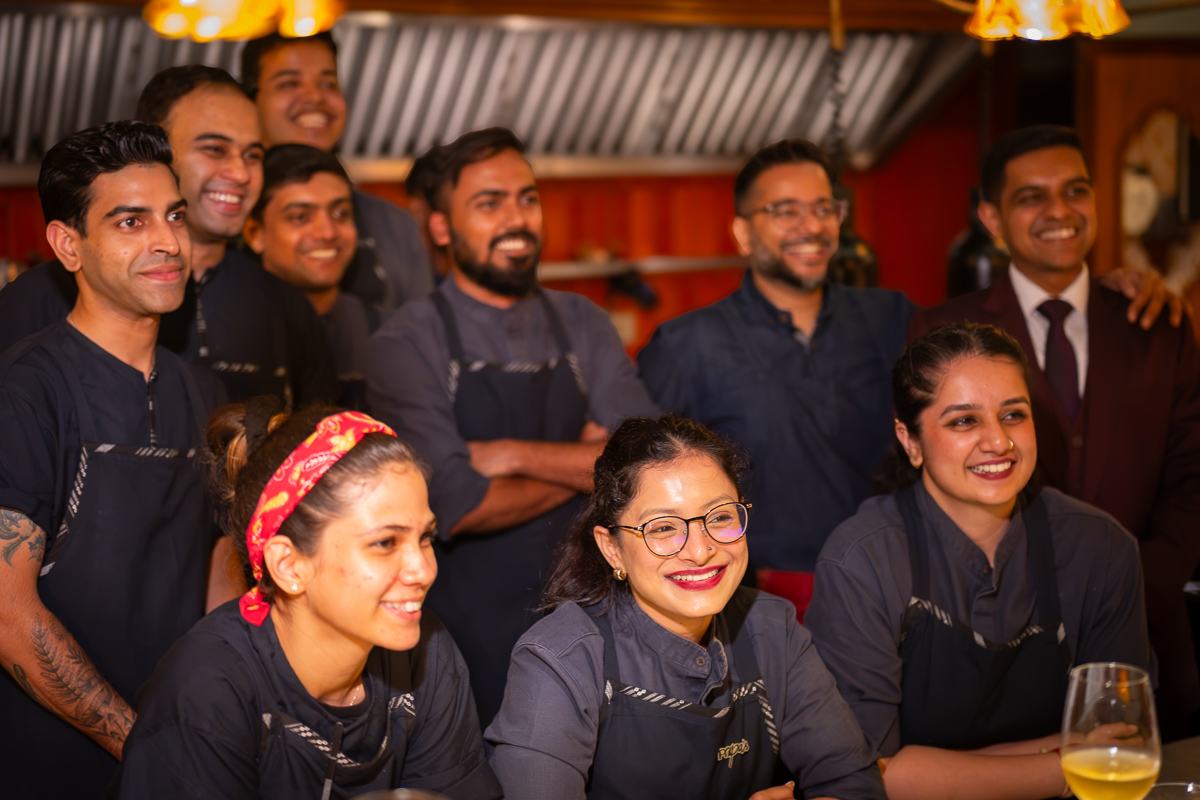
Beside Hussain stands Shivargha Chakravarti who, like the chef, came out of the Oberoi school and went on to Björn Frantzén‘s Zén in Singapore and to Maaemo in Oslo, where he was junior sous chef in a three-Michelin-star kitchen. He preps, plates, serves and talks each guest through the details of every dish. Front of house, and everywhere at once, is Madhusudhan Kashyap, known as Madhu: general manager, in charge of the wine and, as will become clear, master of ceremonies.
Twelve chairs in a U, level with the work surface, with no glass and no pass between those who cook and those who eat: a young, irreverent, Indian reading of the Japanese counter. The top is made from the wood of The Bombay Canteen’s first bar and inset with stone discs that spin between the fingers, designed for fidgets like me. I never let go of mine.
Sweet or savoury?
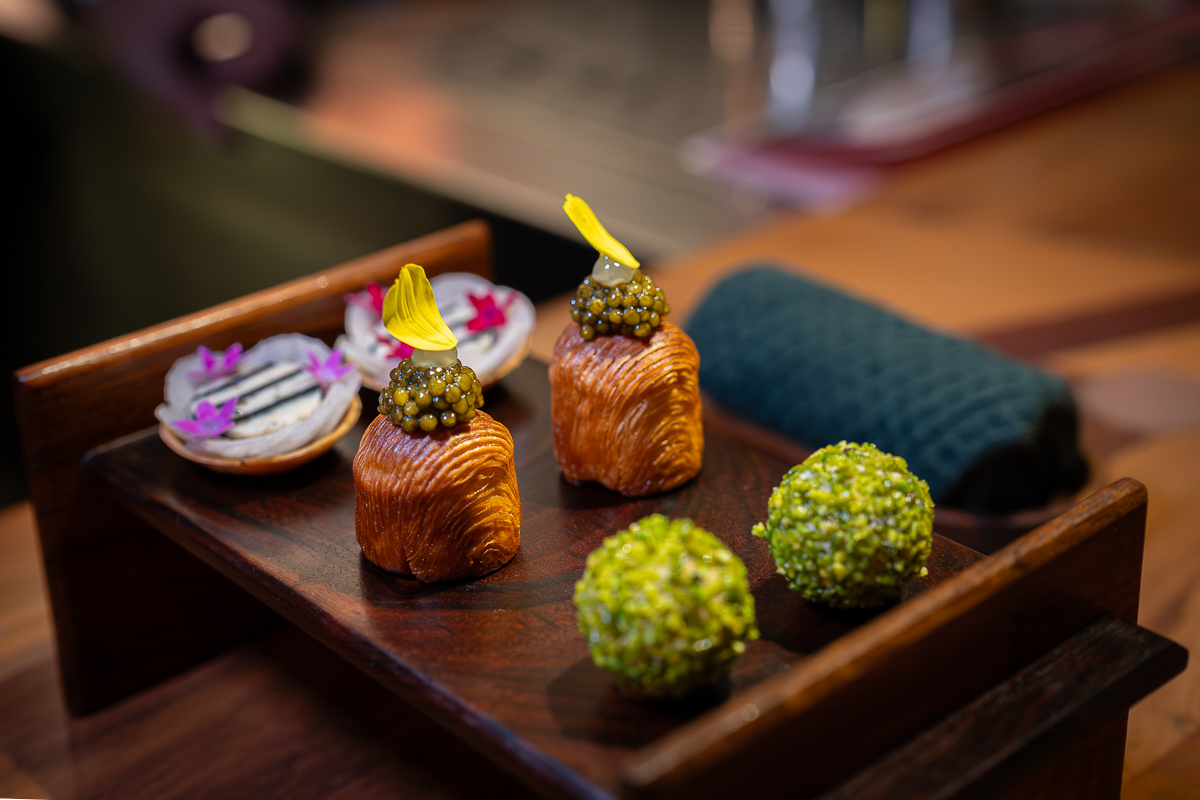
The evening begins standing in the little bar, like a party at a friend’s house. The Negroni was my answer to one of the questionnaire’s questions, and here it arrived reworked, as a welcome and the first sign of hospitality. Then came Champagne from Bérêche et Fils and, with it, the menu’s first joke. In a Bohri home, important meals open with a pinch of salt and go straight to the sweets, and Hussain keeps the rule his own way: the three snacks that open the menu are shaped like traditional Indian sweets but carry the flavours and components of savoury dishes. The laddoo holds quince, pistachio and foie gras. The mawa khaja, a flaky sweet from Bihar, the chef’s mother’s home state, is topped with caviar. The bebinca, Goa’s layered dessert, is made from celeriac, truffle and dates. Together they trace the path of the man who made them, intentionally or not: foie gras from the New York years, his mother’s Bihar, the Goa of O Pedro. Three small bites, and the chef’s biography is told. And told well: caviar popping on the flaky mawa khaja, and a bebinca light and fresh in a way its usual version could never be.
Swapped shapes
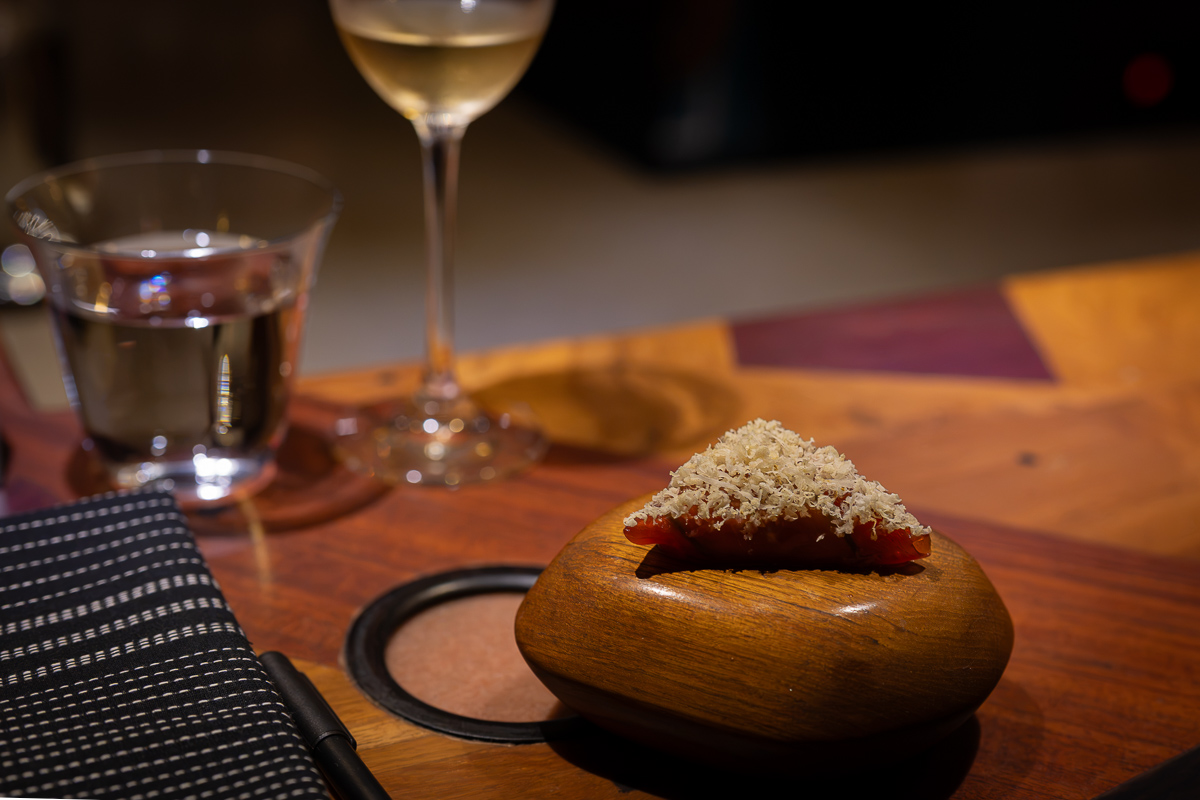
Once seated at the counter, you soon hear the rule inherited from Cardoz that the chef likes to talk about: with a new dish, you change the form or the flavour, never both at once. The samosa proves the rule can be broken. It is everything a samosa should not be: soft. Tuna carpaccio stands in for the pastry, wrapped around chamomile jelly under grated horseradish. The chamomile plays the tea: samosa and chai, India’s favourite pairing, in a single gesture. The cold tuna gives way where the pastry should crack. The idea is witty, but I confess I struggled to let go of the memory of crackling pastry and a juicier, punchier filling, especially after tasting the traditional samosas Hussain had made the night before. Here, form and flavour changed in one go, and the samosa got lost along the way.
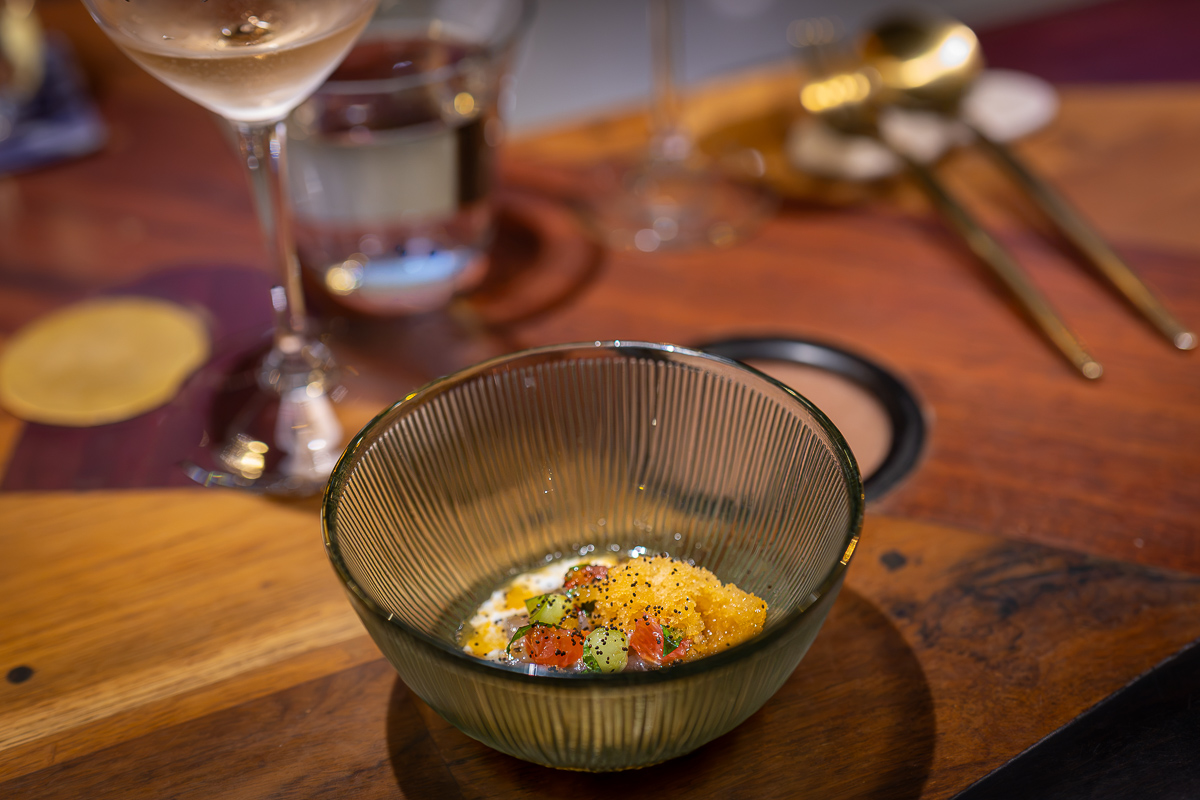
The red snapper curry answered back. Lightly smoked and seasoned with citrus, it comes with coconut cream, grapefruit, cucumber, mango granita and poppy seeds: India’s answer to ceviche, in the form of a curry. Fresh and precise. Alongside, Madhu poured a Grauburgunder from the Weinod x Sippschaft line, which Marco Müller, of the Weinod wine bar in Wiesbaden, makes with growers in the Pfalz and Rheinhessen. Finding a German bar’s own label on a Bandra wine list says a lot about the curiosity of whoever put it together.
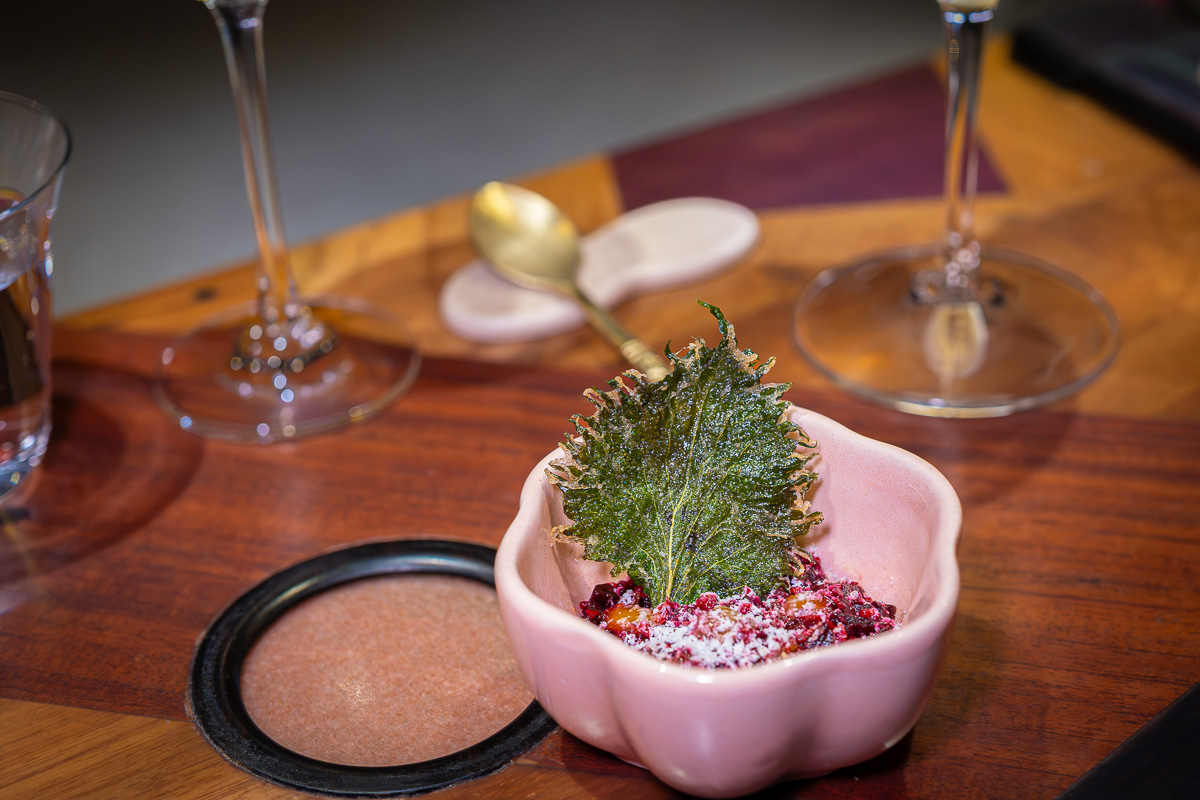
Thayir sadam, the curd rice, comfort food of Chennai, arrives creamy, with beetroot tartare, garlic emulsion, and a tempura shiso leaf standing in for papadum. The textural contrast is beautifully resolved. In the glass, Radikon’s Slatnik from Oslavia, on the border between Friuli and Slovenia: Chardonnay and Friulano fermented together on their skins, a skin-contact white, amber in colour, from one of my favourite producers in the region. It was a pleasure to meet it again in a pairing in Bombay.
Before the ants
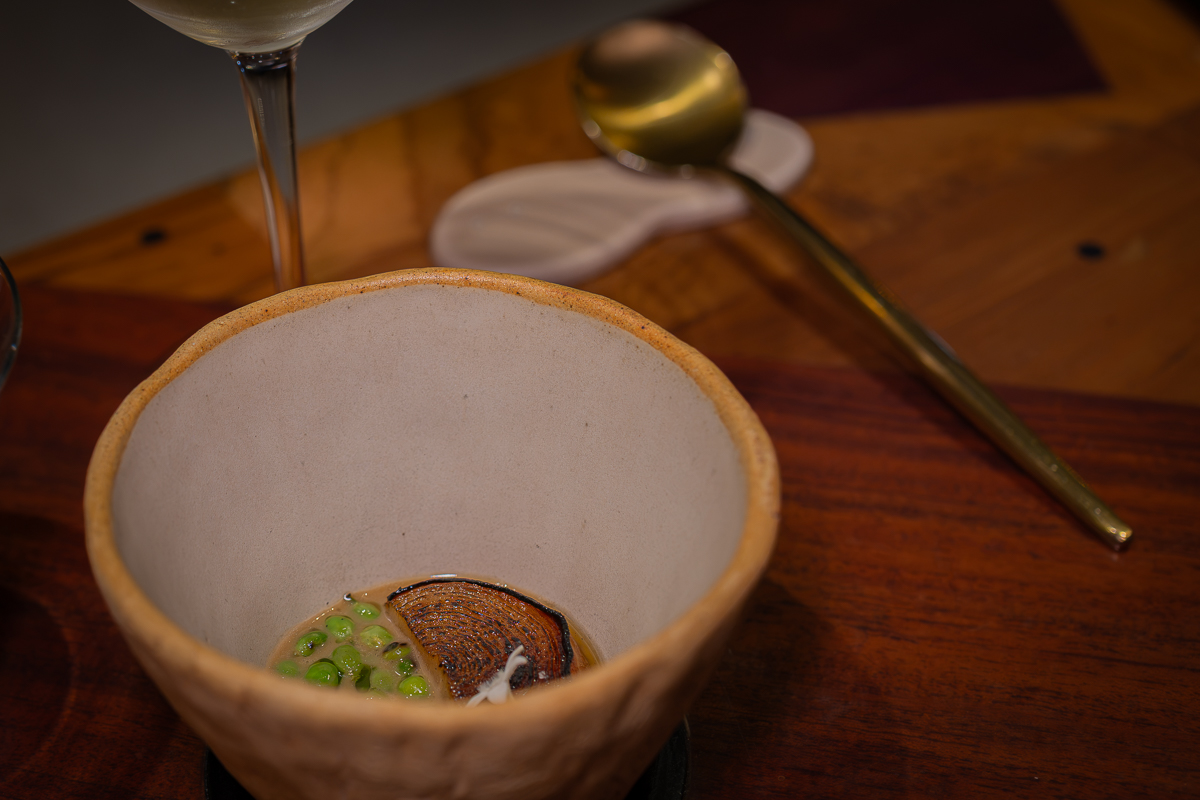
Next came the soup, with turnip and teardrop peas lightly charred over the flame, in a broth of chhurpi, the Himalayan yak’s-milk cheese, alongside a 2024 Grüner Veltliner from Loimer, in the Kamptal. Vegetable warmth against the dairy notes of the chhurpi: a moment of comfort before the ants.
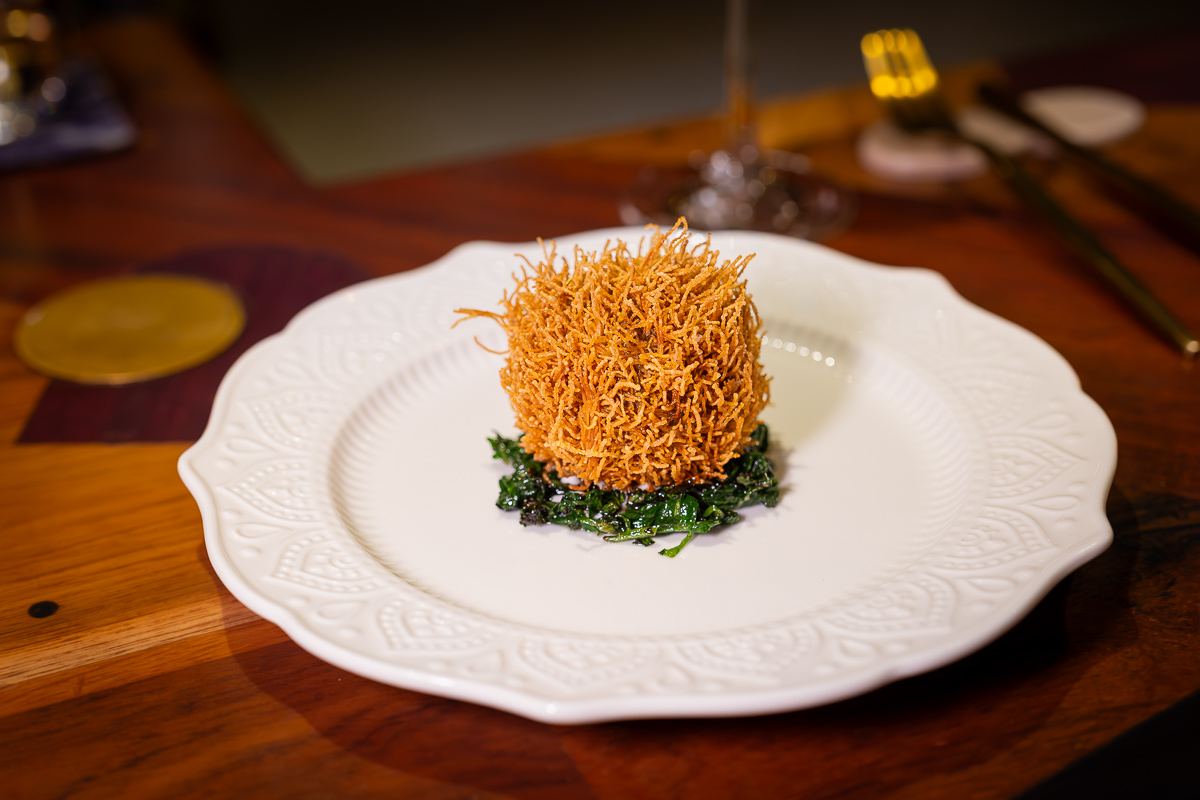
Then came the dish the house calls “Bugs Bunny”, the in-joke that became a signature over the dish’s many versions. The rabbit comes from Nashik and the red ants from Odisha, where the adivasi communities of Mayurbhanj have turned them into a sour chutney for generations. The version I tasted is a rabbit meatball stuffed with ants, wrapped in fine strands of shatteringly crisp pastry that gave the whole a very special contrast of texture, the crunch the samosa lacked, in a dish where the ants are scarier on paper than in the mouth, leaving an almost citrus acidity and freshness. To go with it, Madhu poured Chartogne-Taillet’s Sainte Anne Extra Brut Champagne.
A Chennai street
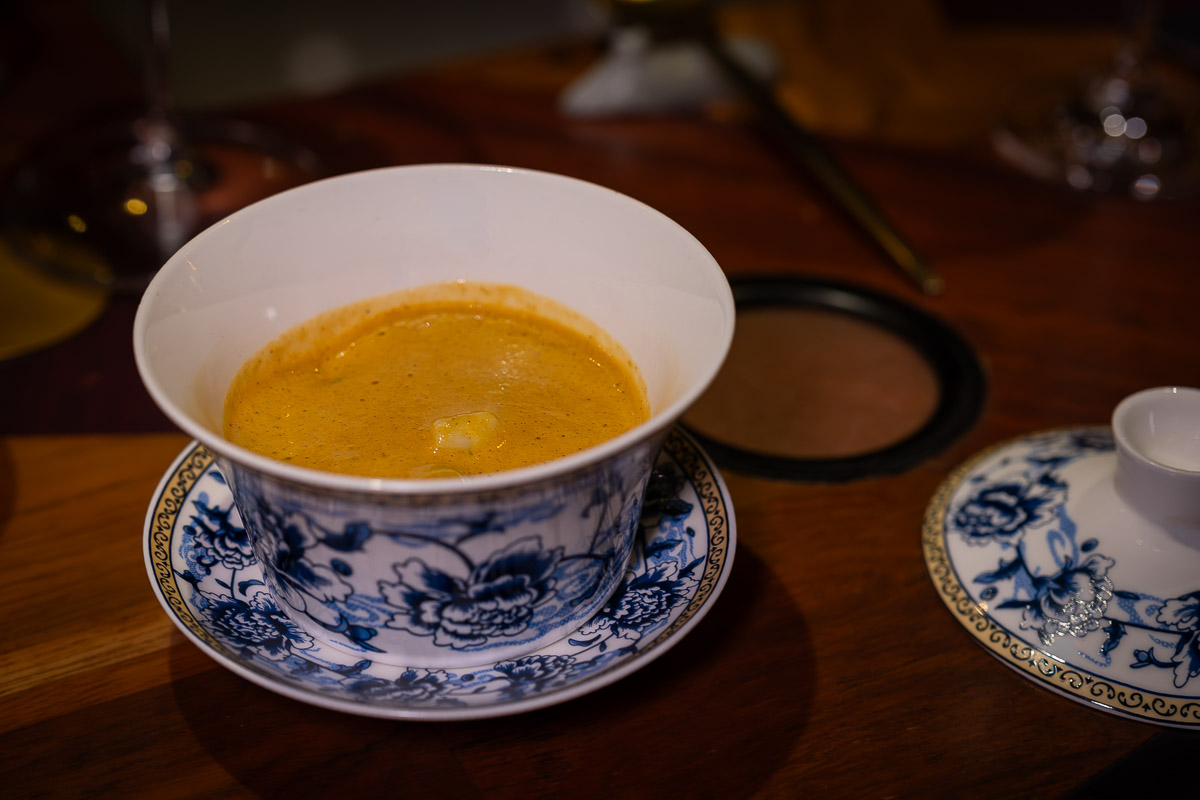
Kothu parotta is Tamil street food: parotta chopped up on the griddle with the blows of a sharp spatula, the rattle announcing the dish before it arrives. At Papa’s, it comes with crab, prawns, cuttlefish, coconut cream and salna, the seafood curry that usually goes with it at Chennai’s street stalls. The execution is flawless, from the cooking of the shellfish to the richness of the cream, where the coconut never takes over: it was one of the high points of the meal. In the glass, Sandhi’s Central Coast Chardonnay, by Rajat Parr, born in Calcutta and trained at the same hotel school as the chef. Two boys from the same school, one in the kitchen and one in the vineyard, brought together on the same plate half a world apart.
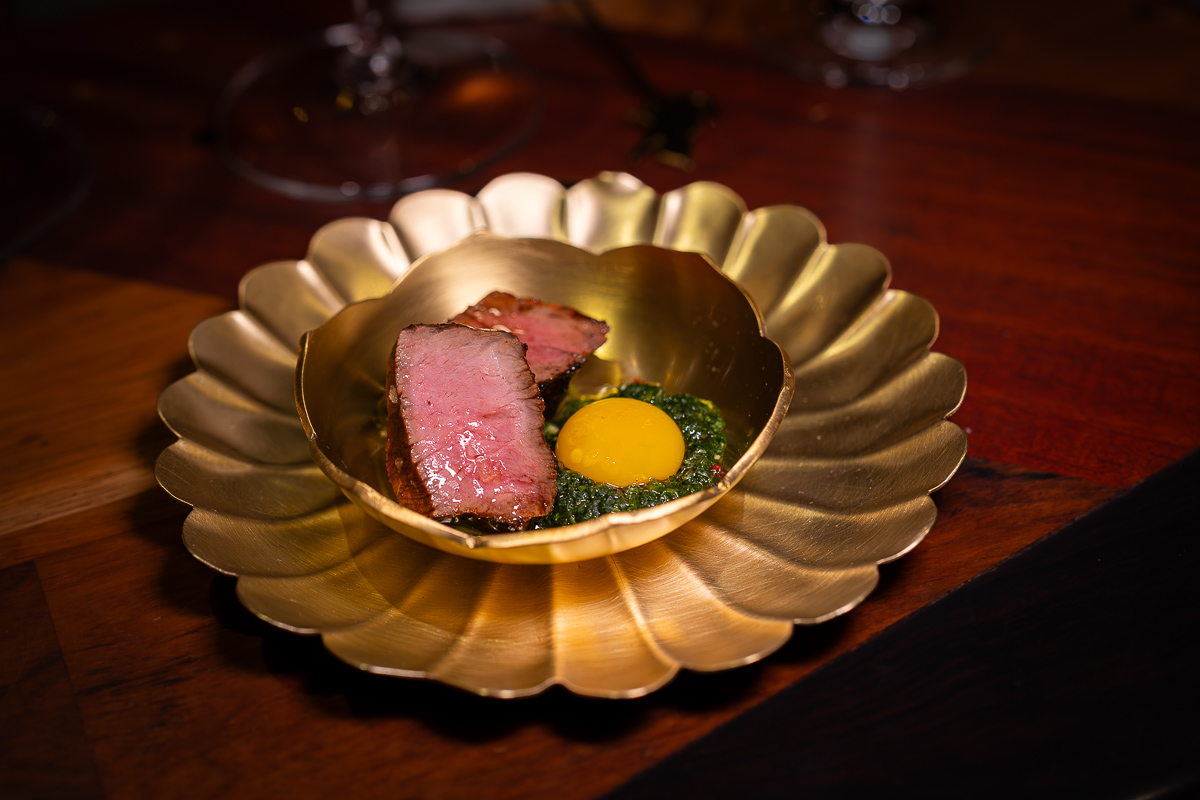
The pork kebab came next, cooked to the point, pink and marbled like wagyu, served with egg yolk, kachampuli (Coorg’s dark vinegar) and culantro. Fat, acidity and yolk closed the dish with nothing left over. Another of my favourites of the night. With it, a 2019 Blaufränkisch from Heinrich, in Burgenland.
The new bread
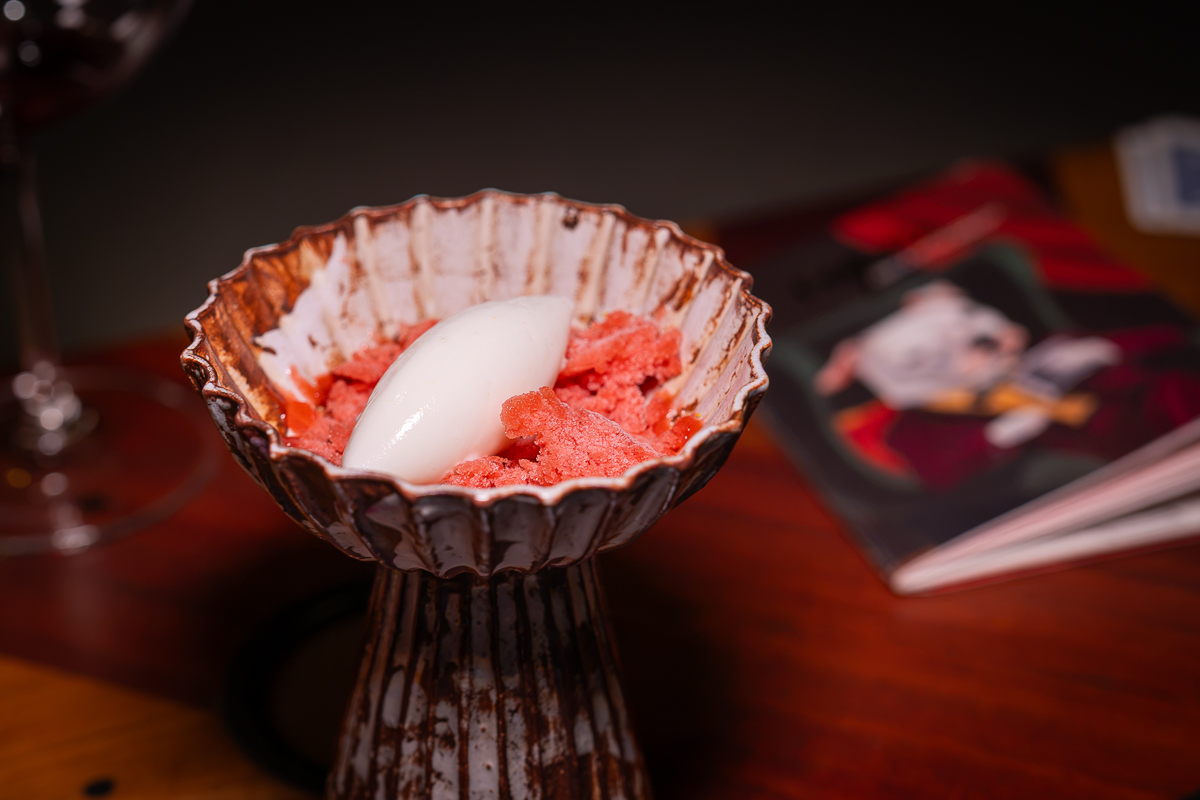
Before the more intense dishes came a “salad” that turned out to be ice cream: a caprese with basil oil and tomato-and-strawberry granita, a palate cleanser with a sense of humour.
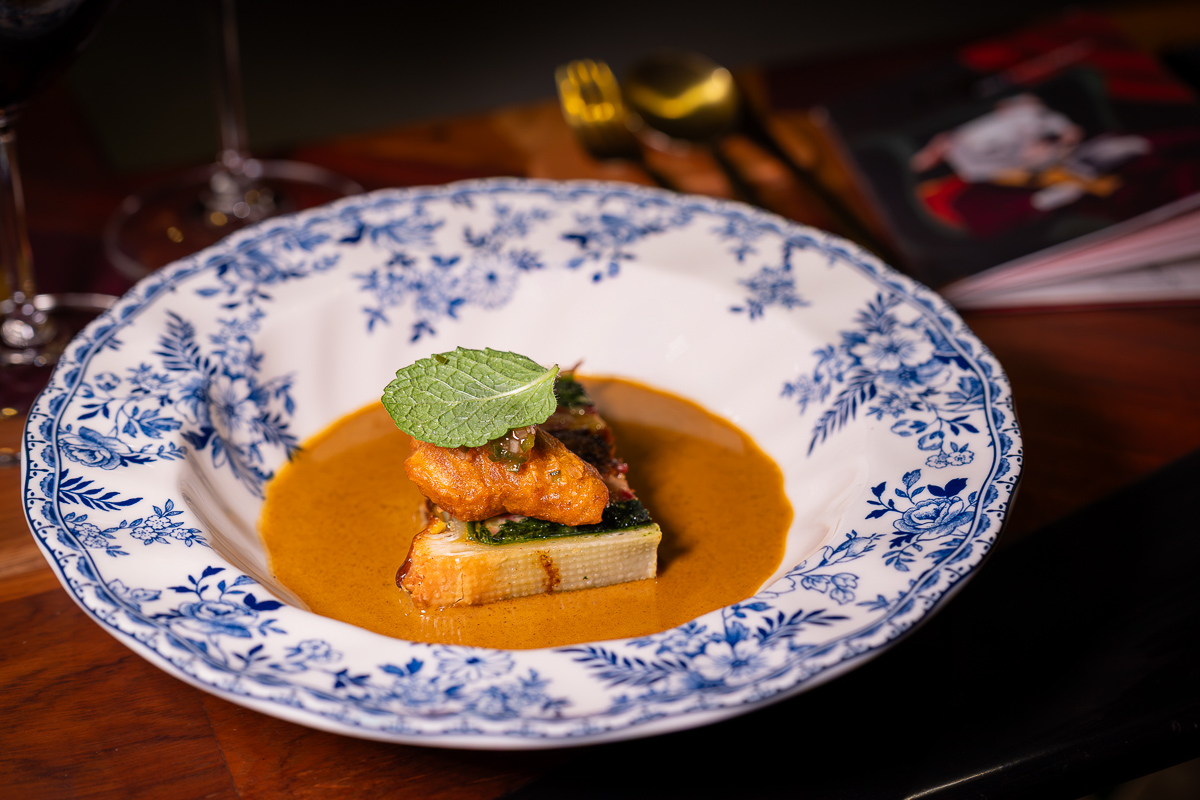
After that came the pithivier, already famous, perhaps the most serious and best-known dish in the house. It is a lamb nihari in a terrine wrapped in puff pastry, served over its own sauce. Pastry baked in the oven like bread, in a building that was a bakery for 80 years, will always be a tribute to its past. My technical quibble is with that same pastry, which could have been baked better, particularly the base. A few more minutes in the oven, or different airflow, and the dish would land where it means to. Everything else was immaculate, down to a bheja pakora, brains fried in batter and properly crisp.
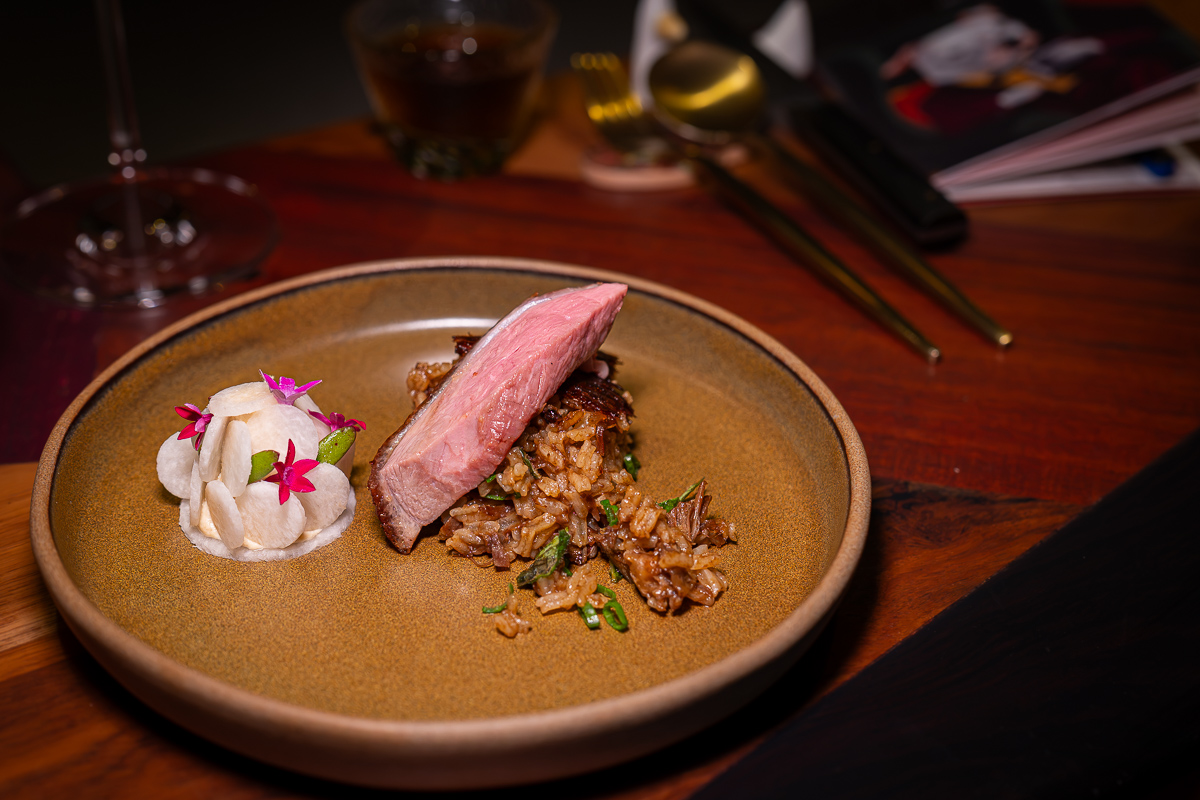
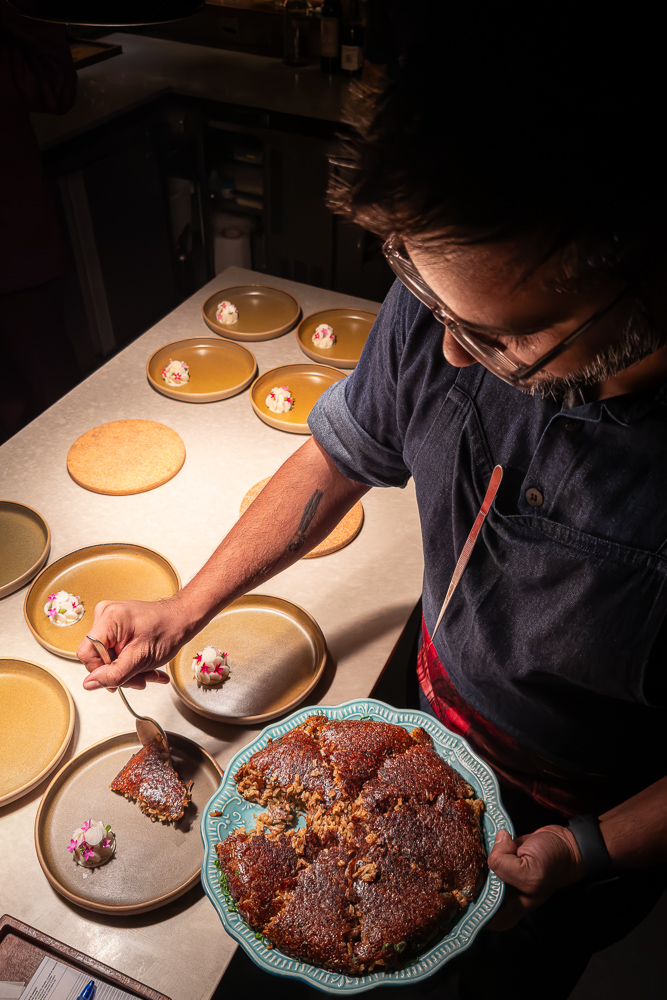 “What the Duck” closed the savoury courses, and what a way to do it. Roast duck breast with crackling skin, looking good enough to set the whole counter salivating as everyone reached for cameras and phones, served with raita and Indrayani rice from Maharashtra in the form of a biryani, finished with socarrat, the toasted crust of a paella. We all have a right to the crisp bottom of the pot, and it is what makes this biryani what it is. The most insatiable among us, myself included, went back for more duck and rice. And since we had learnt the day before that biryani is eaten with Coca-Cola, alongside Le Cabanon, a northern Rhône Syrah from Maison Les Alexandrins, came a house-made cola.
Never say no to dessert
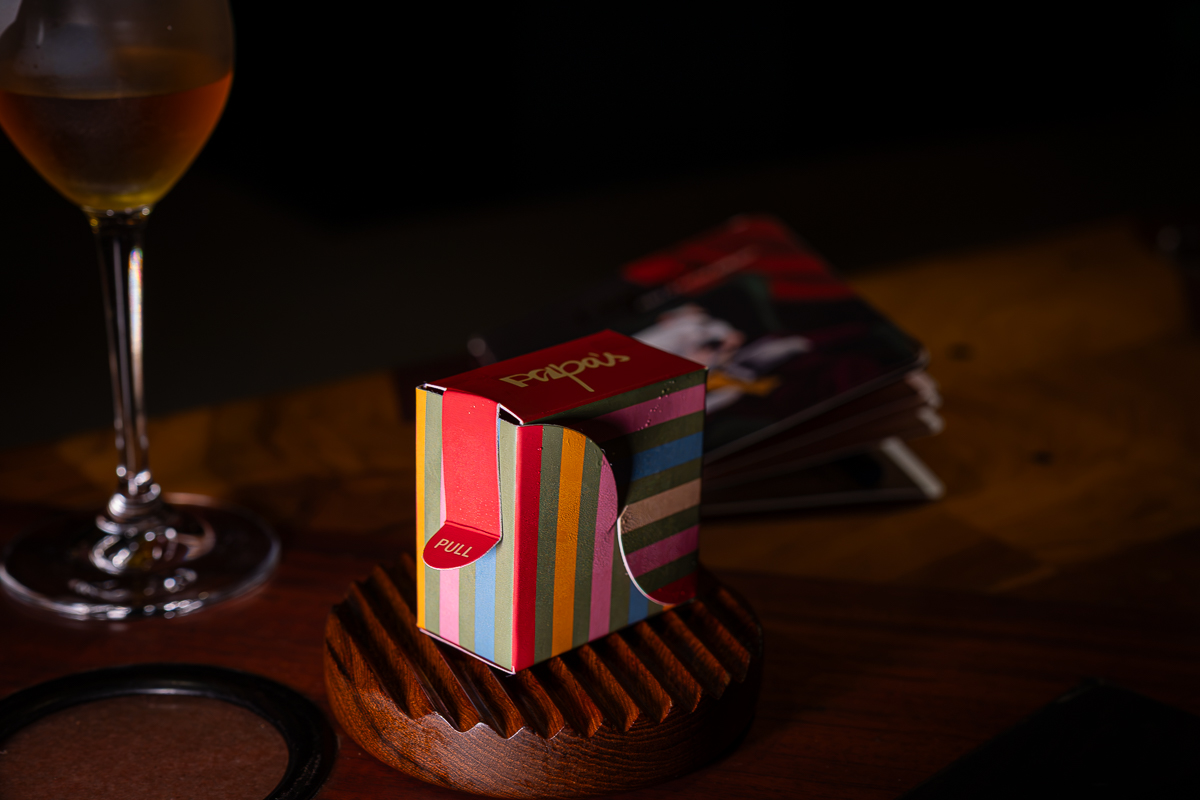
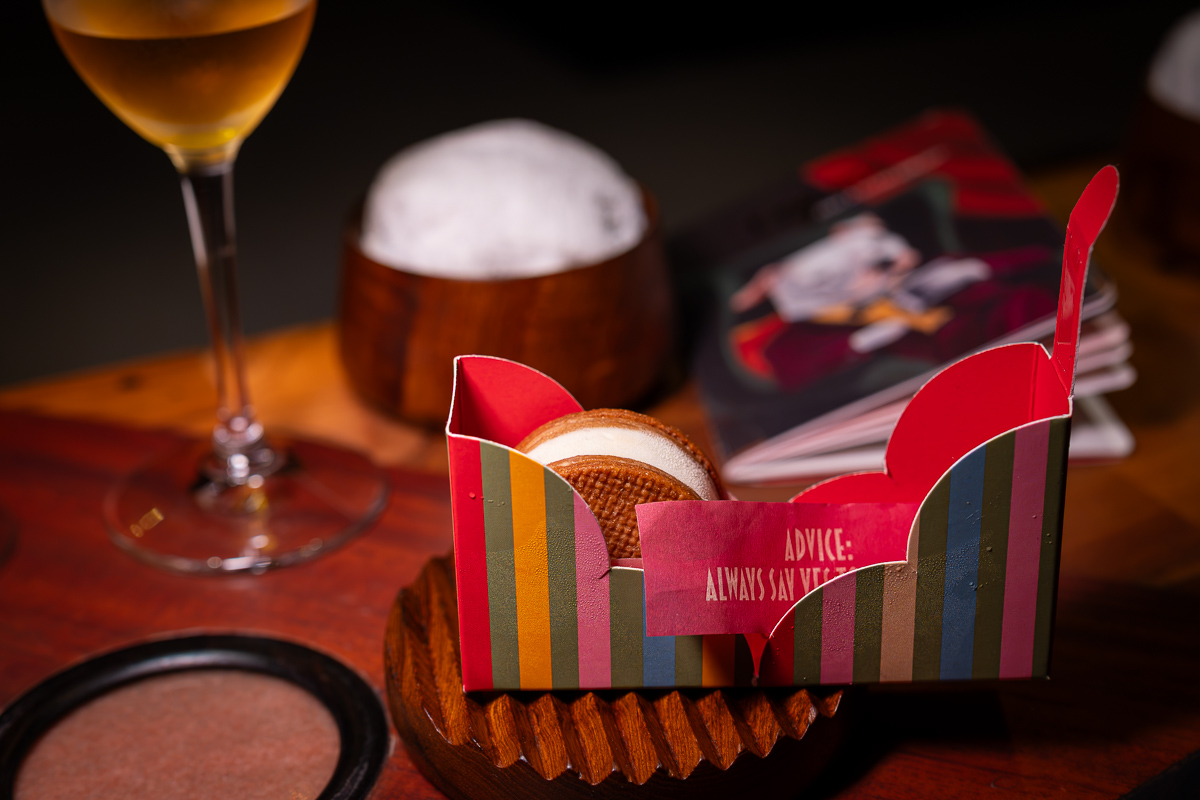
The first dessert arrives in an impeccably designed box: a cheese and fig ice-cream sandwich with a message tucked inside, like a Chinese fortune cookie. Mine read never say no to dessert. I obeyed without blinking; I have never been able to resist ice cream between two biscuits.
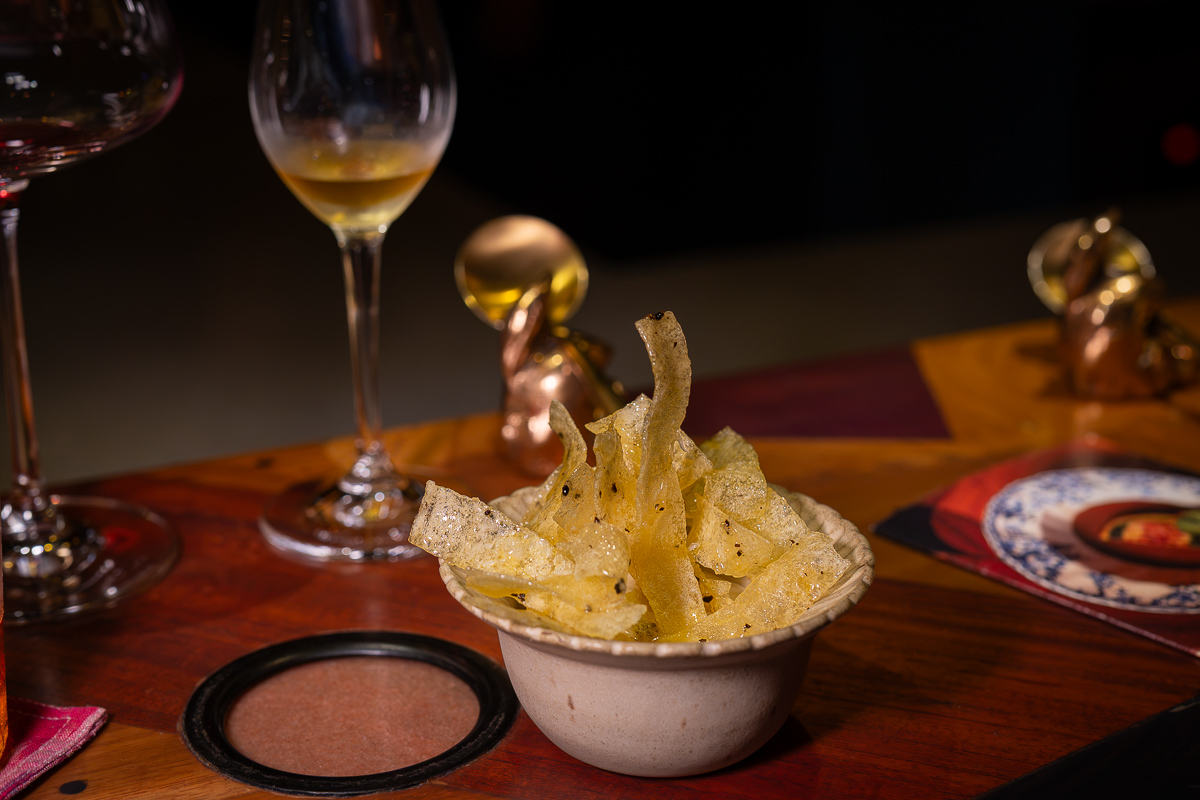
The last is what gave rise to the entire menu. Hussain spent months in front of a blank menu before finding his starting point in darsaan, the honey-glazed strips of fried noodles that India’s Indo-Chinese restaurants serve with vanilla ice cream.
At Papa’s, they become the thinnest potato chips over lemon sorbet, with Champagne and honey: sweet, salty, sour and crunchy on one spoon. If dipping fries from a famous burger chain into a sundae is already a craze, this version justifies it. To finish, an Indian wine: Vallonné Vin de Passerillage 2024, a sweet white made from Chenin Blanc laid out on straw to dry in the sun for a month, concentrating its sugars. A pleasant surprise, its honeyed notes of fig and apricot well matched by the acidity.
On the wine
Wine in India is expensive and hard work, between taxes, slow imports, thin distribution and a market still learning to drink. Madhu is a devotee who does a lot with a little. He builds pairings of distinctive choices at moderate prices in a country where every European bottle is a small luxury. That night’s sequence crossed Germany, Friuli, Austria, Champagne, California, Bordeaux and the Rhône, and ended in Nashik. It is a considered list, built around producers who prefer their own rules to the appellation’s, much like the cooking they accompany.


The magic of a gesture
When there is no food in front of us and no cutlery chiming against the plates, the rest of the night has a name: Madhu. There were necklaces, rings, card tricks, shots and toasts shared with the team, unforced smiles and house stories. One of them was about the night they served the rapper Nas, told on purpose to make me jealous once he knew how deeply I admire him. Colouring books sit on the counter, the stone discs still under my fingers and, threaded through the playlist, the songs each of us chose, a hybrid that put ABBA next to Rampa and Nas — all wrong, and all strangely right! It is a lesson in hospitality on several levels, and it does not happen by chance on a single night.
An interactive experience takes more than a counter, and it needs no domes with projection mapping or 4D gimmicks either: just people who know how to welcome, for human contact is the great promise of luxury in the age of AI.
And thanks to Madhu‘s talent and energy, this was the most fun meal I had in 2026, among people I barely knew, which says a great deal about the outstanding work of the team behind that counter.
And the heat?
If I have a reservation, it is about temperature. Here and there I felt some sauces could have carried a little more of the punch that defines Indian cooking. I felt too comfortable. As a foreigner less moulded by these flavours, I was hoping for the odd blow that would leave me pleasurably uncomfortable, as the home-cooked meal chef Hussain Shahzad made the day before had done, to some extent. Even so, everything was excellent, all the more so given the menu price and how hard certain produce is to come by.
A final note
In an attic in Bandra, tucked above an old neighbourhood bakery, a Bohri cook born in Chennai confirms that India’s moment at the table is beginning. In recent years, the country has won over the food world past its borders: Gaggan is a global phenomenon, Himanshu Saini took Trèsind Studio in Dubai to the coveted three Michelin stars, and across Europe new projects are bringing traditional Indian recipes up to the standards of haute cuisine. Today, many of the cooks who left to deepen their knowledge abroad are coming home and cooking the flavours of their country with new confidence, and Bombay is where you feel it most, with Papa’s as its boldest and most fun proof. It opened in February 2024 and, two years on, sits at No. 66 on the extended Asia’s 50 Best list, ranks as India’s third-best restaurant for Condé Nast Traveller India and was named by TIME in 2025 among the world’s greatest places. None of this helps you get a seat.
I went expecting to see and be seen, with reservations gone in seconds and celebrities doing anything for a seat at the counter.
I found a house you enter by a staircase hidden behind a coffee machine, where you are welcomed like an old friend.
Papa’s could have been one more among many: there is no shortage of fake speakeasies and counters imitating omakase. But here it all sounds different: the attention, the friendliness, the hospitality and the surprise, sparked step by step by the dishes and the exchanges. It is one of those places you leave feeling you received more than you paid for, and a bill that favours the diner is increasingly rare in fine dining or, as would make more sense here, in fine fun dining.
Would I have liked a stronger blow of heat or spice here and there, and a detail or two fixed? I would! But Papa’s does not cook for foreigners or for our assumptions about Indian food. The restaurant is made by its Bombay regulars, who are after other notes and other details. Even so, I won’t let go of one idea: that the petit fours should be Hussain‘s traditional samosas, with form and flavour where they have always been. I suspect Cardoz would agree, and so would the locals. It would be like the prego, the steak sandwich that closes a seafood feast in Lisbon or Porto.
When I came down the stairs, Veronica’s had already shut, its colourful façade dark, and the street had finally gone quiet, a rare thing in Bombay. That impossible mix of music and magic was still playing in my head. In my pocket, the slip from dessert with its simple order: never say no to dessert. I’ll add a clause of my own: nor to a seat at Papa’s counter, if your finger is quick enough at 11am local time on the 1st of each month.